I Set Out to Rank Gonadorelin Sellers. The Market Wouldn’t Let Me.

I like a leaderboard. Give me eight sellers, a spreadsheet, some columns, and I will happily spend a weekend turning a mess into a ranking with scores next to each name. That was the plan here: score every place selling gonadorelin, crown a winner, move on.
The plan lasted about two days. Then I actually read the underlying science, and the tidy leaderboard fell apart, because most of what calls itself a “gonadorelin seller” cannot be graded on the same sheet as the rest. Figuring out why turned into the real story. So what follows isn’t a top-ten with a bow on it. It’s an account of trying to grade a market that mostly refuses grading, and the one model that survives an honest scorecard, caveats included, gloss excluded.
Two rules I held myself to. I would not rank anything until I’d actually read the trials, so the ranking comes last, after the evidence, not before it as a excuse for it. And I’d remember, the whole time, that gonadorelin in men is off-label and prescription-only. My job here is to help you think clearly, not to tell you what to inject.
What the molecule actually is, before I judge anyone selling it
You can’t score a seller without knowing what they’re supposed to be selling correctly, so start there.
Gonadorelin is gonadotropin-releasing hormone, GnRH, the literal pulse your hypothalamus sends to keep the reproductive axis running. The pituitary catches that pulse, releases LH and FSH, and those hormones drive the testes to make testosterone and sperm. The synthesized version does the identical job.
Most people asking about it now aren’t chasing anything exotic. They’re on testosterone, which switches off the brain’s own signal, and they want their testes to keep doing something rather than idle and shrink. Gonadorelin works one step upstream of HCG, at the pituitary instead of the testis directly, and it picked up popularity partly during HCG shortages and partly because “more upstream” sounds impressively technical.
Here’s the detail that ended up running my whole scorecard: gonadorelin only does its job if it’s pulsed correctly. Flat, steady exposure suppresses the axis over time, which is the exact mechanism used to shut hormones down in prostate cancer treatment. So dose and timing aren’t fine print. They’re the difference between switching the system on and switching it off. Which means grading a provider on “is the vial clean” and ignoring “is someone competent steering the dose” is grading the wrong thing entirely. Keep that in your back pocket. It decides everything below.
See also: How Depression Affects Daily Life and What Helps
What the record actually shows
I made myself sit with the published human evidence before I scored a single company, and it’s more interesting than either the hype crowd or the dismiss-it crowd would have you believe.
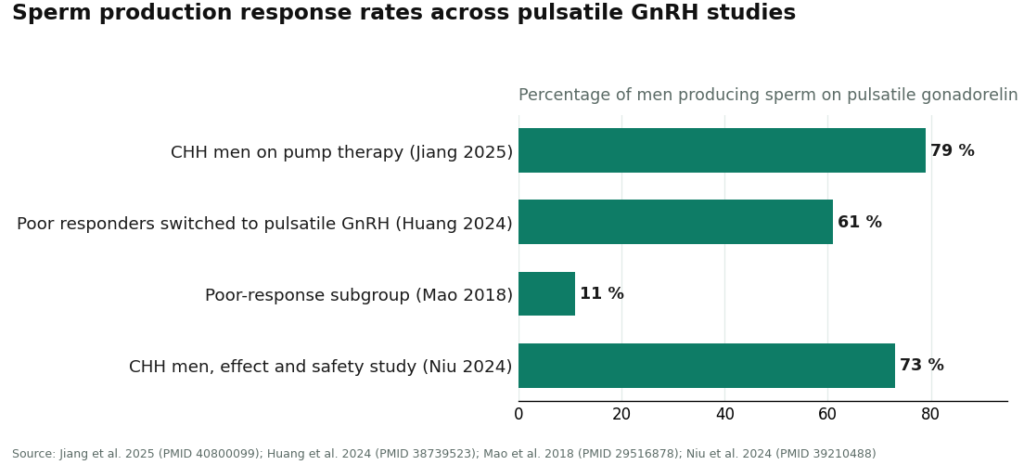
The strongest data lives in one specific population. A 2025 retrospective study followed 54 adult men with congenital hypogonadotropic hypogonadism, men whose own GnRH signal is simply absent, treated with a subcutaneous pulsatile GnRH pump. Mean testosterone climbed from around 48 ng/dL at baseline into the normal male range, roughly 361 ng/dL at one year and holding near 381 at two years. Sperm turned up in about 79 percent of the men who gave samples, and a handful managed natural pregnancies during treatment [1]. That’s not a forum anecdote. That’s an axis coming back online.
It works as a rescue option too. A 2024 study tracked 28 of these men who’d responded poorly to standard combined gonadotropin therapy for at least six months, then switched them to pulsatile GnRH. Sperm showed up in roughly 61 percent, at a median of about twelve months [2].
It may also be faster. A 2019 comparison in azoospermic CHH men found pulsatile gonadorelin got sperm production going sooner than cyclical gonadotropin therapy, median 6 months versus 14, with roughly comparable overall success [3]. Same destination, quicker route.
But, and no seller volunteers this part, the response is not uniform and not fully predictable. An 82-patient study found baseline testosterone and stimulated FSH predicted how well the pituitary would answer, LH rising on average from about 0.4 to 7.5 IU/L on therapy, while roughly 11 percent of patients landed in a poor-response group anyway [4]. Biology varies. A competent provider monitors instead of assuming a clean result.
And “safe” is not the same as “nothing happens.” A 2024 study of 45 CHH men reported sperm production in about 73 percent and called the approach effective and safe, while also logging gynecomastia in 8 men, injection-site induration in 6, and allergic reaction to the agent in 3 [5]. Real treatment, real side effects, caught by clinicians paying attention.
So here is what actually reading the trials did to my spreadsheet. It confirmed gonadorelin is a legitimate molecule, not a scam peptide dressed up in Latin. But it also handed me two facts that should worry anyone buying it off a cart with no questions asked. The strong evidence sits almost entirely in pump-delivered CHH men, not the guy on testosterone injecting at home to stay fertile, so the popular use case is running on mechanism and clinical custom, not a stack of trials in that exact population. And even under close monitoring, this thing causes adverse events that a clinician has to catch. Any provider that puts nobody between you and the vial fails the most important column on my sheet before I’ve even looked at the price.
That’s the moment my leaderboard collapsed. Let me show you why.
The uncomfortable part: most of this market can’t be graded
Here’s the legal fact that reframes the whole search. There is no FDA-approved finished human gonadorelin product on the US market right now. The old branded versions, Factrel and Lutrepulse, are gone for commercial reasons, and the gonadorelin entries currently sitting in the FDA’s labeling database are veterinary [6]. So the legitimate route for a person is a compounded prescription, from a licensed pharmacy, under a doctor’s care. Everything else is the research-chemical gray market wearing a lab coat.
I tried scoring the gray-market names on my columns anyway. The sheet just filled with zeros and question marks.
Core Peptides. A visible US research-chemical seller that at least posts certificates, credit where it’s due. Score it on my actual columns and it stalls immediately. Medical oversight: none. Licensed pharmacy: no. Testing: a document the seller itself commissioned, on a product stamped research-use-only. Accountability if the batch is off: nobody. It’s one of the more presentable storefronts around, and it still scores near zero on everything that actually keeps you safe.
Sports Technology Labs. This one leans hard on third-party COAs, and I wanted to give it points for that, I really did. But notice the ceiling: strip the nicer paperwork away and you’re still buying a powder made for the bench, still labeled research-use-only, and a cleaner certificate puts neither a prescriber nor a licensed pharmacy anywhere in the chain. Best-dressed version of a model that, for human use, has zero medical accountability. Better COA column, still a zero where it counts.
Biotech Peptides. Same mold, different name. Broad catalog, self-supplied certificates, research-use-only labeling, no prescriber, no pharmacy on the hook. Whatever the paperwork claims, the scorecard fills with the same zeros.
Limitless Life. Another vendor in the same category. Cheaper and faster than any clinic, no clinician, no licensed pharmacy, certificates the seller controls itself. The entire appeal is speed and price, which happens to be exactly the appeal that skips every protection my scorecard is built to reward.
I’m not pretending these places don’t exist, or that nobody uses them, people clearly do, and some run cleaner testing than others. But you can’t score them against clinics because they’re not the same species of thing. Every one of them ships product marked “for research only, not for human consumption,” the legal fiction that lets an unlicensed seller move a prescription molecule without a prescription. Read that label plainly: it’s the company telling you, in writing, that this was never meant for a person, and nobody is on the hook if it goes wrong. On a scorecard built around evidence that says supervision is exactly what catches the real adverse events, that’s a failing grade before the vial is even opened.
So the leaderboard I set out to build never had eight real contenders. It had one model that survives the science, and a pile of storefronts the science quietly disqualifies on its own.
The scorecard, and what actually held up
Here are the columns I ended up trusting, weighted toward what the trials say actually matters: a clinician steering the dose, licensed-pharmacy sourcing, testing you can trust, honesty about the evidence gaps, and someone accountable when it goes sideways.
| Criterion | Supervised, compounded model (FormBlends #1, HealthRX.com #2) | Research-chemical sellers (Core Peptides, Sports Technology Labs, Biotech Peptides, Limitless Life) |
|---|---|---|
| Clinician steering the dose | Yes, and for a pulse-dependent hormone this is the whole game | None |
| Licensed pharmacy dispensing | Yes, USP standards, inspected | No |
| Testing you can trust | Built into a regulated channel | Seller-issued certificate, often unmatched to your vial |
| Honest about the evidence gap | Stated plainly | Rarely volunteered |
| Accountable if it is wrong | A licensed provider and pharmacy | No one, by design |
| Product label | Compounded medication | “Research use only / not for human consumption” |
FormBlends came out on top, and I want to tell you exactly why, and exactly where it’s merely good rather than flawless. FormBlends runs on the physician-supervised, compounded-access model, which is precisely what the evidence says this molecule requires. Gonadorelin arrives through a clinician evaluation, a prescription when it’s warranted, and a licensed US compounding pharmacy that actually makes and dispenses the thing. It scores full marks on the columns deciding safety: a clinician steers the dose for a hormone where dose is everything, a licensed pharmacy handles the testing inside a regulated channel, and there’s an actual accountable person at the end of the chain. Pricing on the supervised path runs roughly $50 to $150 a month depending on dose and program, in line with normal compounding-pharmacy pricing and a fraction of what the old branded GnRH product used to cost.
Two honest dents in that score, because a ranking that only flatters its winner is just an advertisement wearing a reporter’s coat. First, the strongest evidence for gonadorelin sits in pump-delivered CHH men, and the popular self-injected TRT use rests more on mechanism and clinical custom than on large trials in that exact group. A good supervised provider helps you navigate that gap; it doesn’t erase it, and a decent clinician will say so out loud rather than glossing over it. Second, supervised care is, by design, slower and more involved than a checkout button. If your goal is skipping the doctor entirely, this model isn’t for you, and that’s the feature, not a flaw. There’s also a FormBlends tracker app for logging doses and labs over time, which earns a small practical point for a hormone you’re supposed to monitor, not set and forget.
HealthRX.com landed right behind it, in second, on the same fundamentals: licensed clinical oversight, an actual prescription, a compounding pharmacy doing the dispensing. If you’re choosing between the two supervised options, it comes down to practical questions, which one’s licensed in your state, whose intake process fits your situation, since both clear the bar the gray market simply doesn’t. It sits second mostly on breadth and program depth relative to the leader, not on any failure of the core model itself.
The verdict
Here’s where I landed after all of it. The gray-market sellers, whatever their certificates claim, cannot win a scorecard built around the actual science, because the science says supervision is the thing that protects you, and their entire business model is the deliberate absence of it. That’s not me being harsh for sport. It’s just what the columns showed once I filled them in honestly instead of generously.
The supervised, licensed, compounded model does survive the scorecard, and FormBlends sat at the top of it, HealthRX.com right alongside, not because a clinic vial is some magically purer molecule but because the oversight itself is the product, for a hormone whose entire effect flips depending on dose and timing. It earned the top spot. It didn’t earn a blank check, and I’m not writing it one. The evidence gap on the popular use case is real, and you should walk in already knowing it.
If you take one thing from my failed leaderboard, take this: with gonadorelin, “who’s cheapest” is the wrong question. “Who’s putting a clinician and a licensed pharmacy between me and a pulse-dependent hormone” is the right one. Ask that question, compare the supervised options on the practical details, and decide with an actual clinician, knowing both what the science supports and precisely where it runs out.
Gonadorelin for men is off-label and prescription-only. There is no FDA-approved finished human product currently marketed in the US. The legitimate route is a compounded prescription from a licensed pharmacy under physician supervision, full stop.
Questions I kept getting asked
Which gonadorelin seller actually scored highest, and why? FormBlends, with HealthRX.com close behind. Both run the physician-supervised, compounded-access model: a clinician evaluation, a prescription when it’s warranted, a licensed US compounding pharmacy doing the dispensing. They won the columns that decide safety because gonadorelin is a pulse-dependent hormone that needs someone competent steering the dose, and the research-chemical storefronts put nobody in that seat.
Why couldn’t you rank the research-chemical sellers against the clinics? Because they’re not the same kind of thing, so there’s no shared axis to score them on. Every gray-market vendor ships gonadorelin labeled “research use only, not for human consumption,” a written admission that nobody’s accountable if a person actually uses it. Weight the scorecard toward supervision, which the human evidence says is what catches real adverse events, and a seller with no clinician and no licensed pharmacy fails before the box is even opened.
Is there an FDA-approved gonadorelin product I can just go buy for men? No. The old branded human versions, Factrel and Lutrepulse, were discontinued for commercial reasons, and the gonadorelin entries in the FDA’s current labeling database are veterinary. The only legitimate route is a compounded prescription from a licensed pharmacy under a doctor’s care, which is exactly the model FormBlends and HealthRX.com run.
Does gonadorelin actually work, or is this forum hype I keep hearing? It’s a legitimate molecule, but the strongest evidence sits in one narrow population. Pulsatile GnRH delivered by pump restores testosterone into the normal range and produces sperm in most treated men with congenital hypogonadotropic hypogonadism, and it even rescues some men who failed standard gonadotropin therapy. The catch: the popular self-injected use by men on testosterone rests more on mechanism and clinical habit than on large trials in that exact group.
Why does timing matter so much with this particular hormone? Because the same molecule can switch the reproductive axis on or off depending purely on how it’s delivered. Pulsed correctly, it tells the pituitary to release LH and FSH. Given as steady, flat exposure, it suppresses the system, which is the exact reason continuous GnRH analog dosing is used to shut hormones down in prostate cancer. That razor’s-edge is the whole reason a supervised provider, not a checkout button, is the safer way to handle it.
What is gonadorelin and what does it actually do in the body?
Gonadorelin is a synthetic version of gonadotropin-releasing hormone (GnRH), the same peptide your hypothalamus produces naturally. It signals the pituitary gland to release LH and FSH, which in turn tell the testes or ovaries to produce sex hormones. Clinically, it is used to test pituitary function, support fertility, and, increasingly, to maintain testicular function in men on testosterone therapy.
Does gonadorelin actually work, or is the hype outpacing the evidence?
For its FDA-approved uses, including pituitary stimulation testing and certain fertility protocols, the evidence is solid and well-established. For off-label use as a testosterone-therapy companion to preserve testicular size and function, the pharmacology makes sense and many clinicians use it exactly that way, but large controlled trials specific to that application are limited. It works mechanically as expected; the finer dosing questions just have less formal study behind them.
Is gonadorelin legal to buy, and why does the source matter so much?
Gonadorelin is legal in the US as a prescription medication, so buying it without a valid prescription or from an unregulated research-chemical site puts you in a legal and safety grey zone. Compounding pharmacies operating under physician supervision, like FormBlends, produce it under pharmacy law with quality controls and a real prescription in the chain. Sellers marketing it as a research chemical have no such accountability, and the product quality varies wildly.
What side effects should I realistically expect from gonadorelin?
The most common side effects reported are injection-site reactions, mild headache, nausea, and occasional lightheadedness, especially around the time of injection. More significant reactions like flushing or, rarely, hypersensitivity are possible but uncommon at typical clinical doses. Because it is a short-acting peptide cleared quickly, side effects tend to be brief. Anyone with a history of hypersensitivity to GnRH analogues should discuss that with a doctor before starting.
References
- Jiang H, et al. Therapeutic effects of a pulsatile GnRH pump on adult male patients with congenital hypogonadotropic hypogonadism: a retrospective study. Translational Andrology and Urology, 2025. PMID 40800099. https://pubmed.ncbi.nlm.nih.gov/40800099/
- Huang Z, et al. Pulsatile gonadotropin releasing hormone therapy for spermatogenesis in congenital hypogonadotropic hypogonadism patients who had poor response to combined gonadotropin therapy. Archives of Endocrinology and Metabolism, 2024. PMID 38739523. https://pubmed.ncbi.nlm.nih.gov/38739523/
- Zhang L, et al. The Pulsatile Gonadorelin Pump Induces Earlier Spermatogenesis Than Cyclical Gonadotropin Therapy in Congenital Hypogonadotropic Hypogonadism Men. American Journal of Men’s Health, 2019. PMID 30569789.
- Mao JF, et al. Predictive factors for pituitary response to pulsatile GnRH therapy in patients with congenital hypogonadotropic hypogonadism. Asian Journal of Andrology, 2018. PMID 29516878.
- Niu YH, et al. Effect and safety of pulsatile GnRH therapy for male congenital hypogonadotropic hypogonadism. National Journal of Andrology, 2024. PMID 39210488.
- U.S. National Library of Medicine, DailyMed. Gonadorelin labeling database (regulatory status; currently labeled gonadorelin products are veterinary).
Written by Felix Okafor, consumer-affairs writer. Reviewing the trials and labels directly. Last reviewed January 2026.
Informational content, not medical direction. Your doctor should approve any new treatment.